
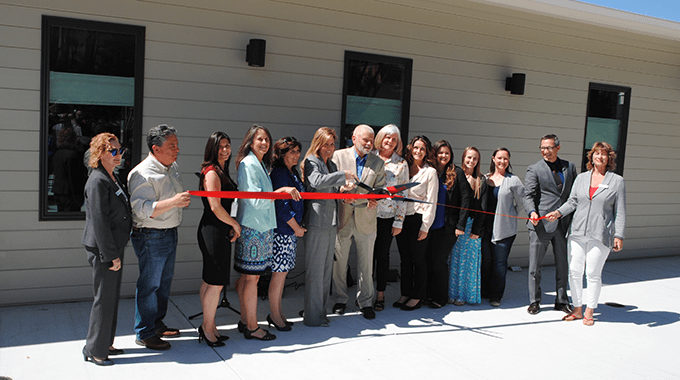
Ribbon cutting at San Luis Obispo County Crisis Stabilization Unit in 2018
By KAREN VELIE
San Luis Obispo County and a contracted mental health group agreed to pay $8 million to the family of a teen who died at a county facility, though it would be eight to 10 hours before anyone noticed the 19-year-old had passed away.
Following the deaths of several mentally ill patients, including Andrew Holland whose family previously received a $5 million settlement, in 2018 SLO County opened a crisis stabilization unit to help community members “experiencing a serious mental health issue.” The county outsourced management of the unit to Sierra Mental Wellness Group.
After staff complained for months about mismanagement at the facility, the teen’s death prompted four employees to hand in their notices. Several employees then contacted CalCoastNews, which exclusively reported on the failures at the unit and the the truth surrounding the teen’s death.
On May 15, 2024, emergency medical personnel transported 19-year-old Elina Branco of Paso Robles to French Hospital Medical Center because of a drug overdose. At the hospital, medical personnel gave the teen multiple doses of Narcan.
Linda Cooper, Branco’s mother, began arranging her daughter’s admission to a dual-diagnosis rehabilitation facility and asked that her daughter be closely monitored overnight until the transfer could occur the next morning.
Jason Hooson, who was part of the SLO Mental Health Evaluation Team, assured Cooper her daughter would receive round-the-clock supervision in a safe, protective environment, at a county four-bed facility. Twelve hours later, at 6:08 p.m., medical staff transported Branco to the SLO County Crisis Stabilization Unit.
“Client requires close monitoring, support and supervision to prevent recurrence of what likely would have been her death,” Hooson wrote. “Parent indicates that she believes client would use again if she were not directly transferred/admitted and fears client will overdose.”
As part of the unit’s intake procedure, staff should have searched Branco for contraband and required her to change into facility clothing. They did not.
Unit staff was also required to check on Branco every two hours. Instead, they allegedly went to sleep.
Between 8 a.m. and 8:30 a.m. on May 16, 2024, an employee noticed Branco was not breathing and that her body was cold. The employee called for the defibrillator, but the battery was dead.
Staff at the unit documented Branco’s stay, noting on her chart that she went to bed at 9:35 p.m.
At 11:30 p.m. on May 15, and again at 1:30, 3:30 and 5:30 a.m. on May 16, the chart logs are identical: “Engaged in therapeutic rest without incident. Breathing is even and unlabored. Will continue to monitor for any changes.”
During shift change at 7:30 a.m., the log entry changes: “The client is lying in bed with eyes closed, breathing evenly and without labored breathing. Relevant information be (sic) passed on the day shift for continuity of care.”
However, it appears no one actually checked on Branco, whom the coroner calculated died between 10 p.m. and midnight on May 15.
In addition, there was not a registered nurse or other medically trained staff present at the facility who could have recognized or responded to a drug-related medical emergency. Instead, a registered nurse signed off on statements made by the allegedly-sleeping psychiatric technicians present at the crisis unit.
“She would still be alive if not admitted to the crisis stabilization unit,” an employee told CalCoastNews shortly after Branco’s death. “It is so bad the clients are in danger.”
Cameron Sehat, the attorney for Branco’s mother, filed a wrongful death lawsuit in federal court seeking monetary damages and closure of the facility. Shortly afterwards, the county shuttered the facility.
The lawsuit names SLO County, Sierra Mental Wellness Group and eight of the group’s employees “for a custom, practice, and failure to train that resulted in chronic understaffing, absent nursing coverage, routinely admitting a client of higher acuity than reasonably safe to manage, unenforced overnight welfare check policies, and falsified monitoring records.”
SLO County’s attorneys argued the county was not responsible for Branco’s death or the chronic mismanagement of the crisis unit. They blamed Sierra Mental Wellness Group.
However, emails Sehat obtained showed county employees were aware the crisis unit was not properly staffed before Branco’s death.
“Plaintiffs contend the county was independently responsible for the incident because it had a non-delegable duty to provide constitutionally adequate mental health services to the public and that it could not simply contract away said obligation to Sierra, a private mental health services contractor,” Sehat wrote. “Plaintiffs also alleged neglect of a dependent adult under the Elder and Dependent Adult Civil Protection Act, negligent training, supervision and retention, and wrongful death under state law.”
In June, San Luis Obispo County and Sierra Mental Wellness Group agreed to settle the case for $8 million to be allocated to Bronco’s parents – Linda Cooper and Jeffrey Bronco, Jr. The portion of the $8 million settlement payment made by both SLO County and Sierra Mental Wellness Group was not disclosed.
Because we believe the public needs the facts, the truth, CalCoastNews has not put up a paywall because it limits readership. However, we are seeking qualification as a paper of record, which will allow us to publish public notices, this requires 5,000 paid subscribers.
Your subscription will help us to continue investigating and reporting the news.


The taxpayers on the hook for another failure by officials who are not held accountable for their crimes